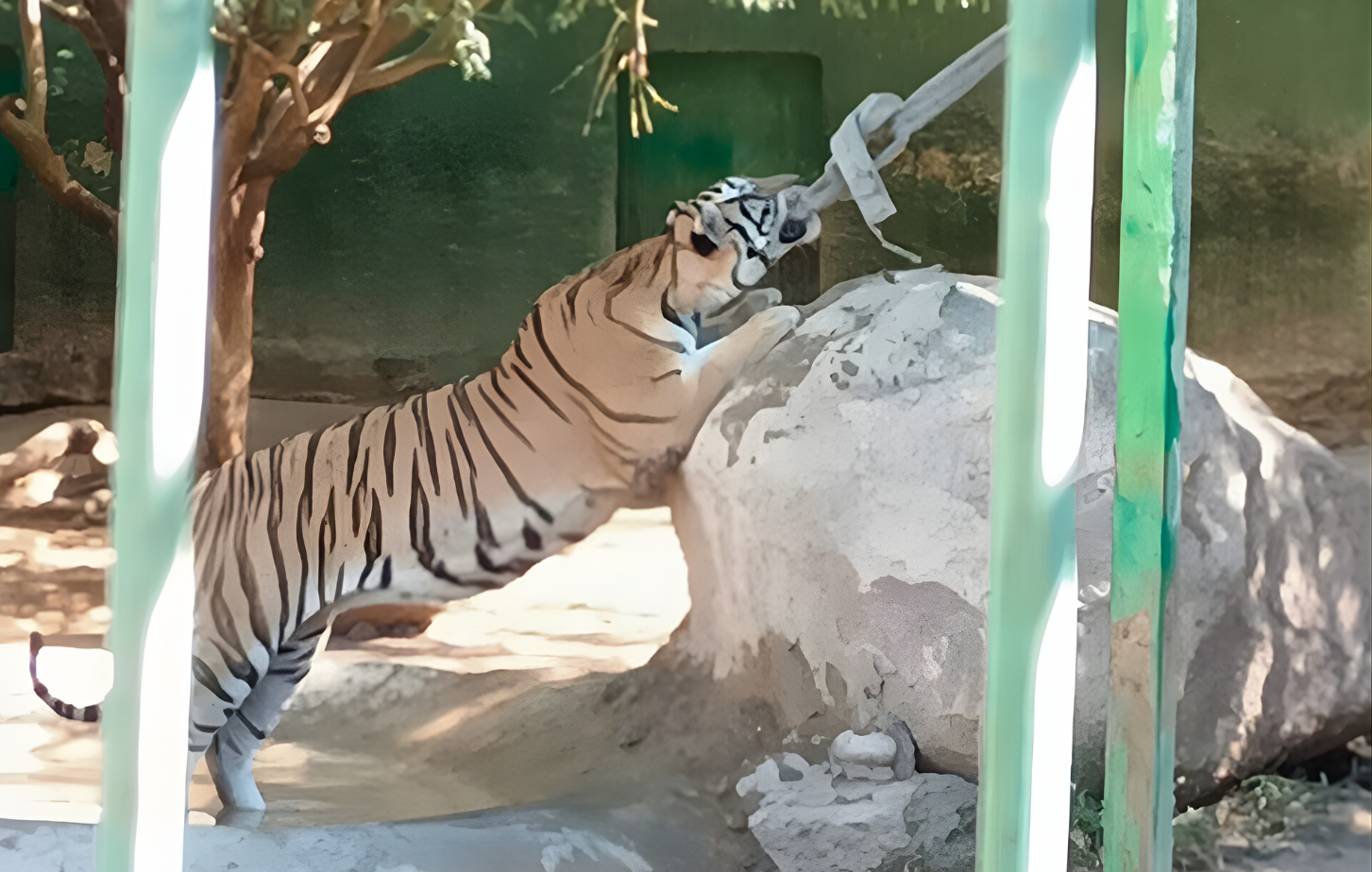
Estimación del bienestar animal e implementación de enriquecimiento ambiental en félidos en cautiverio
Palavras-chave:
bienestar animal, enriquecimiento ambiental, félidos silvestres, comportamiento, UMAsResumo
http://dx.doi.org/10.21929/abavet2026.4
e2024-45
Referências
ALTMANN J. 1974. Observational study of behavior: Sampling methods. Behaviour. 49(3–4): 227–267. ISSN: 0005-7959. https://doi.org/10.1163/156853974X00534
BROOM DM. 2011. Bienestar animal: Conceptos, métodos e indicadores. Revista Colombiana de Ciencias Pecuarias. 24(3): 306–321. ISSN: 2256-2958.
http://www.scielo.org.co/pdf/rccp/v24n3/v24n3a10.pdf
CARLSTEAD K, Shepherdson D. 2000. Alleviating stress in zoo animals with environmental enrichment. Applied Animal Behaviour Science. 72(4): 337–354. ISSN: 1872-9045. https://doi.org/10.1079/9780851993591.0337
CASTILLO GC, Unda HK, Lara C y Serio JC. 2012. Environmental enrichment and its effects on exhibit stereotypic behaviors in jaguars (Panthera onca) from the "Yaguar Xoo" Zoological Park, Oaxaca. Acta Zool. Mex. 28(2): 365-377. ISSN: 2448-8445. https://www.scielo.org.mx/pdf/azm/v28n2/v28n2a9.pdf
CLUBB R, Mason GJ. 2003. Captivity effects on wide-ranging carnivores. Nature. 425(6957): 473–474. ISSN: 1476-4687. https://doi.org/10.1038/425473a
ELLIS SLH. 2009. Environmental enrichment: practical strategies for improving animal welfare. International Zoo Yearbook. 43(1): 156-164. ISSN: 1748-1090. https://doi.org/10.1016/j.jfms.2009.09.011
MALDONADO B, López G, Robles R, Nieblas M, Macillas J, Osuna R. 2022. Validación externa por correlación de la evaluación del bienestar animal de caninos en entrenamiento. Abanico Veterinario. 12(1): 1-22, e2022-7. ISSN: 2448-6132. http://dx.doi.org/10.21929/abavet2022.39
MARTIN P, Bateson P. 2007. Measuring behavior: An introductory guide (3rd ed). Cambridge University Press. Pp.176. ISBN: 978-0521535632.
https://doi.org/10.1017/CBO9780511810893
MASON GJ, Rushen J. 2006. Stereotypic animal behaviour: Fundamentals and applications to welfare (2nd ed). Pp. 384. CAB International. ISBN: 978-0851990040. https://doi.org/10.1079/9780851990040.0000
MELLOR DJ, Beausoleil NJ. 2015. Extending the “Five Domains” model for animal welfare assessment. Animal Welfare. 24(3): 241–253. ISSN: 2054-0469. https://doi.org/10.7120/09627286.24.3.241
MOTA D, Velarde A, Maris S, Nelly M. 2016. Bienestar animal; una visión global en iberoamérica. 3 ed. Elsevier. Pp. 99. ISBN: 978-84-9113-026-0 https://books.google.com.mx/books?vid=ISBN9788491130260&redir_esc=y
SANMIGUEL R, Plazas F, Trujillo D, Pérez M, Peñuela L, DiGiacinto A. 2017. Requerimientos para la medición de indicadores de estrés invasivos y no invasivos en producción animal. Rev Inv Vet Perú. 29(1): 15-30. ISSN:1609-9117. http://www.scielo.org.pe/pdf/rivep/v29n1/a02v29n1.pdf
SCIABARRASI AA, Sensevy A, Cervantes D, Scaglione MA, Delmar R. 2020. Influencia del enriquecimiento ambiental en las conductas de Felis catus, Leopardus geoffrogy y Puma yaguarundi. Revista Colombiana de Ciencia Animal RECIA. 12(2): 1-9. e778. ISSN: 0120-0690. https://doi.org/10.24188/recia.v12.n2.2020.778
YOUNG RJ. 2003. Environmental enrichment for captive animals. Blackwell Publishing. Pp. 240. ISBN: 978-0-632-06407-6. https://doi.org/10.1002/9780470751046
SKIBIEL AL, Trevino HS, Naugher K. 2007. Comparison of several types of enrichment for captive felids. Zoo Biology. 26(5):371–381. ISSN: 1098-2361.
https://doi.org/10.1002/zoo.20147
URRUTIA-MAZZUCA L, Hevia ML, Escribano D, Navarro R. 2023. Environmental enrichment and behavioral indicators in captive wild felids. Animals. 12(18):2415. ISSN: 2076-2615. https://doi.org/10.6018/analesvet.545731
WHITHAM JC, Wielebnowski N. 2013. New directions for zoo animal welfare science. Applied Animal Behaviour Science. 147(3–4):247–260. ISSN: 1872-9045. https://doi.org/10.1016/j.applanim.2013.02.004
Publicado
Edição
Seção
Licença

Este trabalho está licenciado sob uma licença Creative Commons Attribution-NonCommercial 4.0 International License.