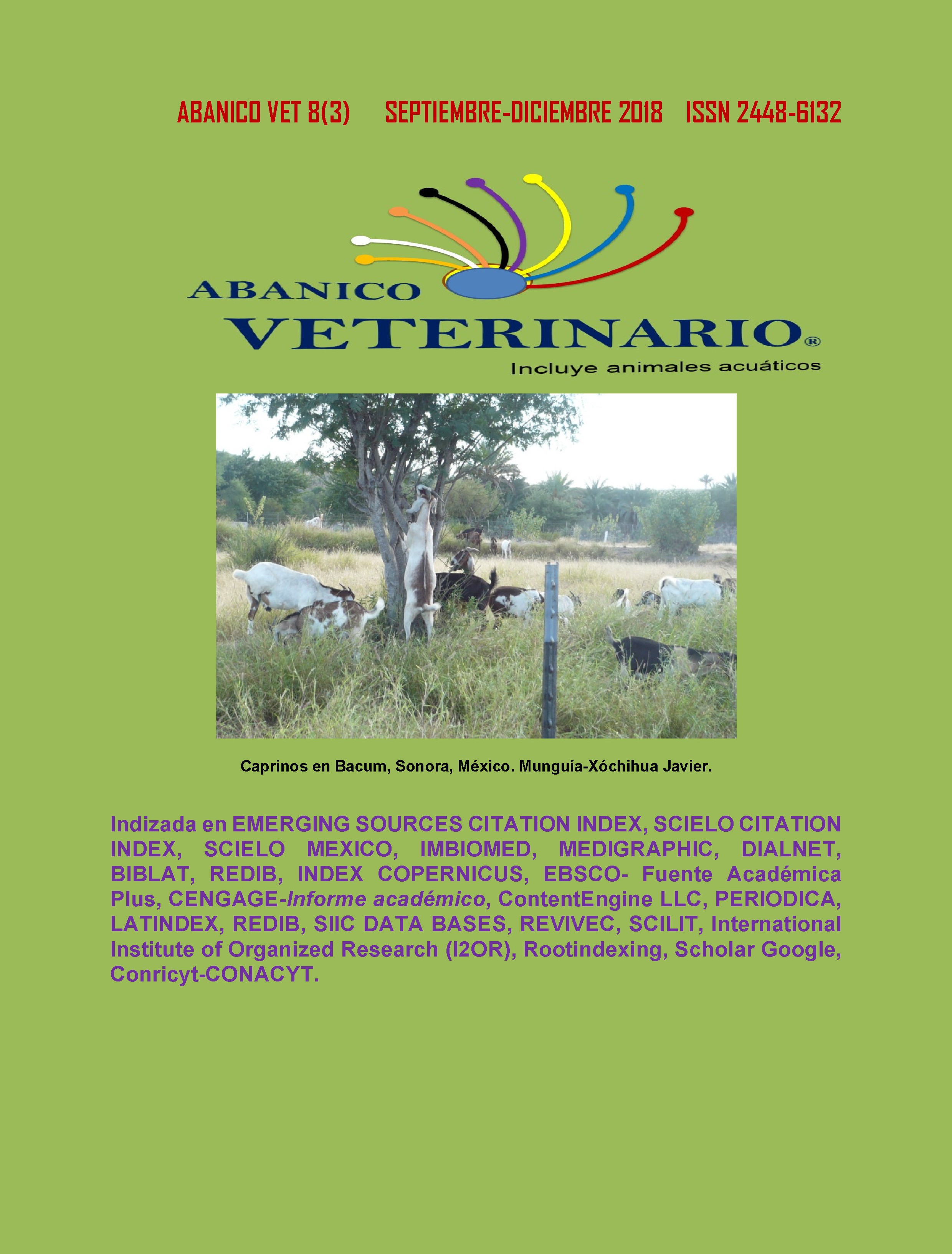
Gastroenteric parasites and parasitic burdens of Haemonchus contortus in goat from the semiarid climate of the Bacum, Sonora, Mexico
Keywords:
BioticAbstract
The gastrointestinal parasites (PGE), and in special Haemonchus contortus (HC) have been adapted to different ecosystems and cause direct and indirect damage to the goat production. In order to determine the frequency of PGE and parasitic burdens of HC in abomasum in naturally infected goats and sacrificed in a local slaughter in Bacum during 2015 to 2017, 1,823 feces samples were collected of adult goats. 815 (42.4%) samples were positive to Strongylidea; 69 (3.69%) were positive to Moniezia expansa and 5 (0.21%) were positive to Skjabinema caprae. In the same period, 770 abomasums were collected and 447 (58.05%) were positive to the presence of adult Haemonchus contortus. The parasitic burden of HC was 50,296: 33,222 (66.05%) female and 17,074 (33.94%) male. The parasite effects and its biotic potential of HC have been reviewed which represents the value of adaptation to different environments that allow the infection of new guests. It is concluded that the presence of PGE and the population of Haemonchus contortus in abomasum represent an abiotic potential essential for adaptation and survival in different environments.
References
AKKARI H, Jebali J, Gharbi M, Mhadhbi M, Awadu S, Darghouth MA. 2013. Epidemiology study of symatric Haemonchus species and genetic characterization of Haemonchus contortus in domestic ruminants in Tunisia. Veterinary Parasitology. 193:118-125. ISSN: 0304-4017. http://dx.doi.org/10.1016/j.vetpar.2012.12.014
ATTINDEHOU S, Salifou S, Biaou CF, Gbati OB, Adamou-N´Diaye M, Pangui LJ. 2012. Epidemiology of haemonchus in sheep and goats in Benin. Journal of Parasitology and Vector Biology. 4(2):20-24. ISSN: 2141-2510, DOI:10.5897/JPVB12.012, http://www.academicjournals.org/JPVB
ALBERTI EG, Zanzani SA, Ferrari N, Bruni G, Manfredia MT. 2012. Effects of gastroitestinal nematodes on milk productivity in three dairy goat breeds. Small Ruminant Research. 106:12-17. ISSN: 0921-4488. http://dx.doi.org/10.1016/j.smallrumres.2012.04.027
ALBERTI EG, Zanzani SA, Gazzonis AL, Zanatt G, Bruni G, Villa M, Rizzi R, Manfredi MT. 2014. Effects of gastrointestinal infections caused by nematodes on milk production in goats in a mountain ecosystem: Comparison between a cosmopolite and local breed. Small Ruminant Research. 120:155-163. ISSN:0921-4488. http://dx.doi.org/10.1016/j.smallrumres.2014.04.017
ANGULO CFJ, García CL, Alunda JM, Cuquerella M, Fuente C. 2010. Biological characterization and pathogenicity of three Haemonchus contortus isolates in primary infections in lambs. Veterinary Parasitology.171:99-105. ISSN: 0304-4017, 0304-4017.
DOI:10.1016/j.vetpar.2010.03.004
BISWAJIT D, Konch P, Rahman T, Upadhyaya TN, Pathak DC, Tamuli SM, Phangchoo CV, Begum SA. 2017. Ocurrence and pathology of Haemonchus contortus infections in goats. Journal of Entomology and zoology Studies. 5(3):1284-1287. E-ISSN:2320-7078, P-ISSN:2349-6800, DOI: http://dx.doi.org/10.22271/j.ento. www.entomoljournal.com,
http://www.entomoljournal.com/archives/2017/vol5issue3/PartR/5-3-122-461.pdf
CHANDANA ChB, Mousumi H, Adbus S, Pranjal B, Pranad D. 2015. Prevalence of gastrointestinal helminth infections in goats at goat research station Byrnithat. International Journal of Advanced Research Biological Sciences. 2(4):297-305. ISSN: 2348-8069, DOI:10.22192/ijarbs(Crossref, USA), ICV:57.38 (2015), www.ijarbs.com.
EMERY DL, Hunt PW, Jambre LFL. 2016. Haemonchus contortus: the then and now, and where to form here?. International Journal for Parasitology. 46(12): 755-769. ISSN: 0020-7519. http://dx.doi.org/10.1016/j.ijpara.2016.07.001, www.parasite.org.au/parasite.html.
FTHENAKIS GC, Papadopoulus S. 2017. Impact of parasitism in goat production. Small Ruminant Reseach. Article in Press. ISSN: 0921-4488.
http://dx.doi.org/10.1016/j.smallrumres.2017.04.001
MAHESHIKA SK, Pradeepa S, Dematawewa CMB, Ariyaratne HBS, Rajapakshe RPVJ, Wickramaratne SHG, Jayasooriya LJPAP, Munasinghe DMS, Lokugalappatti LGS, Notter RR. 2018. Responses of Sri Lankan indigenous goats and their Jamnapari crosses to artificial challenge with Haemonchus controtus. Veterinary Parasitology: Regional Studies and Reports- 11:41-48. ISSN: 2405-9390.
https://doi.org/10.1016/j.vprsr.2017.11.011
NAHAR L, Sarder MJU, Mondal MMH, Faruque MO, Rahman M. 2015. Prevalence of haemonchosis of goats at Rajshahi district in Bangladesh. Bangladesh Journal of Veterinary Medicine. 13(1): 29-36. ISSN: 2308-0922, DOI: http://dx.doi.org/10.3329/bjvm.v13i1.23713,
https://www.banglajol.info/index.php/BJVM/article/view/23713
RASHID S, Irshadullah M. 2018. Epidemiology and seasonal dynamics of adult Haemonchus contortus in goats of Aligarh, Uttar Pradesd, India. Small Ruminant Research. 161:63–67. https://doi.org/10.1016/j.smallrumres.2018.01.018.
ROMERO JR, Boero CA. 2001. Epidemiología de la gastroenteritis verminosa de los ovinos en las regiones templadas y calidad de la Argentina. Analecta Veterinaria. 2(1):21-37. ISSN: 1514259-0,
www.produccion-animal.com.ar/sanidad...ovinos/63-gastroenteritis_ovina.pdf
RUMOSA GF, Chimonyo M, Dzama K. 2009. Prevalence and loads of gastrointestinal parasites of goats in the communal areas of the Eastern Cape Province of South Africa. Small Ruminant Research. 84:132-134. ISSN: 0921-4488.
doi:10.1016/j.smallrumres.2009.06.013
SIMPSON HV. 2000. Pathophysiology of abomasal parasitism: Is the host or parasite responsible?. The Veterinary Journal. 160:177-191. ISSBN:1090-0233.
DOI:10.1053/tvjl.2000.0491, thttp://www.idealibrary.com on
THURSFIELD M. 2018. Veterinary Epidemiology. Wiley-Blackwell Publishing. USA. Fourth Edition. 266-269 p. ISBN: 978-1118280287.
TORRES-ACOSTA JFJ, Hoste H. 2008. Alternative or improved methods to limit gastrointestinal parasitism in grazing sheep and goats. Small Ruminant. 77:159-173.
ISSN: 0921-4488. DOI: https://doi.org/10.1016/j.smallrumres.2008.03.009
PETRIE A, Watson P. 2010. Statistics for veterinary and animal science. Blackwell Publishing. Second edition. 45-52 p. ISBN-1-4051-2781-3.
VINEER HR, Steiner J, Knapp-Lawitzke F, Bull K, Son-de Fernex EV, Bosco A, Hertzberg H, Demeler J, Rinaldi L, Morrison AA, Skuce P, Bartley DJ, Morgan ER. 2016. Implications of between-isolate variation for climate change impact modelling of Haemonchus contortus populations. Veterinary Parasitology. 166:119-123. 229:144-149. ISSN: 0304-4017. http://dx.doi.org/10.1016/j.vetpar.2016.10.015.
WAYNE WD. 2014. Bioestadística: Base para el análisis de la ciencia para la salud. Cuarta edición. Ed. Limusa-Wiley. México, D.F. 1-12 p. ISBN:97896818643.
YACOB Ch, Mistre AH, Adem AH, Basu AK. 2009. Parasitological and clinical responses of lambs experimentally infected with Haemonchus contortus (L3) with and without ivermectin treatment. Veterinary Parasitology. 166:119-123. ISSN: 1873-2550, ISSN: 0304-4017. doi:10.1016/j.vetpar.2009.07.038. https://www.ncbi.nlm.nih.gov/pubmed/19683874
YUSOF AM, Lokman M. 2016. Prevalence of gastrointestinal nematodiasis and coccidiosis in goats from three selected farms en Terengganu. Malaysia. Asian Pac J Trop Biomed. 6(9);735-739. ISSN:2221-1691. http://dx.doi.org/10.1016/j.apjtb.2016.07.001
ZVINOROVAA PI, Halimani TE, Muchadeyi FC, Matika O, Riggio V, Dzama K. 2016. Prevalence and risk factors of gastrointestinal parasitic infections in goats in low-input low-output farming systems in Zimbabwe. Small Ruminant Research. 143:75-83. ISSN: 0921-4488, http://dx.doi.org/10.1016/j.smallrumres.2016.09.005