Stimulation of callus and organogenesis in Leucaena greggii S. Watson explants
Keywords:
organogenesis, callus formation, micropropagation, phytohormones, leucaenaAbstract
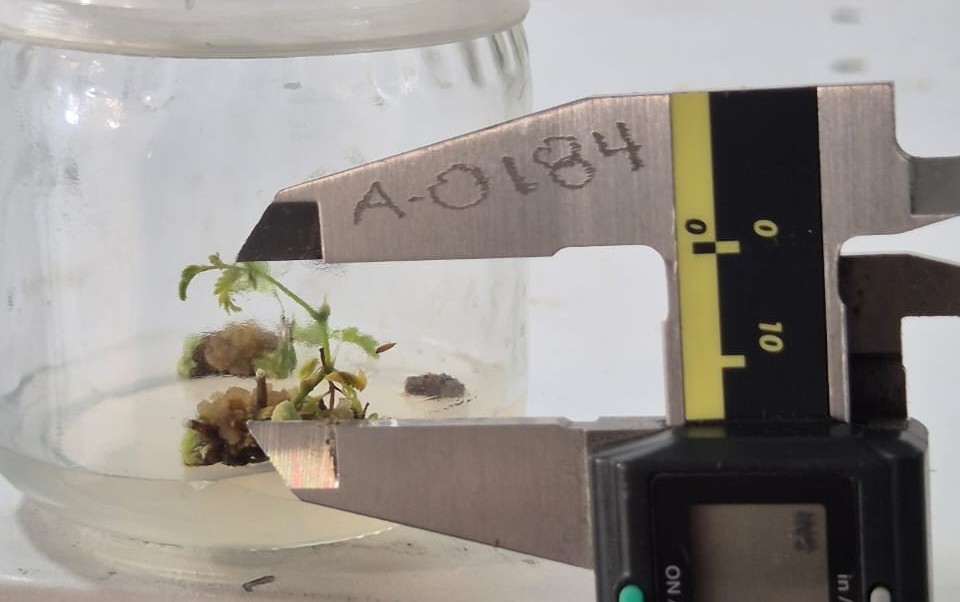
Leucaena greggii belongs to the Fabaceae family and is a species native to northeastern Mexico. It has uses as forage, medicinal plants, timber, and food for humans. Currently, it is threatened by habitat loss and overgrazing. The objective of this research was to stimulate callus formation and organogenesis in Leucaena greggii explants (stem, axillary bud, and leaf). For this purpose, WPM culture medium supplemented with indolebutyric acid (IBA) was used at different concentrations (0, 1.25, 2.5, and 3.75 mg L⁻¹). An ANOVA and a Tukey-Kramer test for mean comparison were applied. The results showed no significant differences between treatments for callus formation induction, with average callus heights of 4.514 mm and widths of 6.042 mm. The treatment that resulted in the greatest growth in callus height and width was the axillary bud with a concentration of 2.5 mg L⁻¹. Furthermore, organogenesis was also observed in the axillary bud and stem, as seen in five explants with concentrations of 2.5 and 3.75 mg L⁻¹. The overall contamination percentage was below 2%, and the oxidation percentage was 100% in the leaf explant, which is more susceptible to stress than the other plant organs. It should be noted that the disinfection protocol for this species was appropriate.
http://dx.doi.org/10.37114/abaagrof/2026.2
e2026-2
References
BIANCHETTI RE, de Resende CF, Pacheco VS, Dornellas FF, de Oliveira AM, Freitas JCE, Peixoto PHP. 2017. An improved protocol for in vitro propagation of the medicinal plant Mimosa pudica L. African Journal of Biotechnology. 16(9):418-428.
https://doi.org/10.5897/AJB2016.15831
DAGO Y, Milian-Domínguez JC, Calzadilla-Reyes K, Redonet-Miranda MDLÁ, López-Quintana Y, Hernández-Guanche L. 2020. Uso potencial de Leucaena leucocephala Lam. (leucaena) presente en sistemas agroforestales de Pinar del Río. Revista Cubana de Ciencias Forestales. 8(1):154-162. https://cfores.upr.edu.cu/index.php/cfores/article/view/511
ESTRADA-CASTILLÓN E, Yen-Méndez C, Delgado-Salinas A & Villarreal-Quintanilla JA. 2004. Leguminosas del centro del estado de Nuevo León, México. Anales del Instituto de Biología. Serie Botánica. 75(1):73-85.
https://www.redalyc.org/pdf/400/Resumenes/Resumen_40075105_1.pdf
GLOBAL invasive species database. 2025 Species profile: Leucaena leucocephala. https://www.iucngisd.org/gisd/speciesname/leucaena+leucocephala
JMP (Statistical Discovery LLC). 2022. Discovering JMP® 17. Cary, NC: JMP Statistical Discovery LLC. https://www.jmp.com/es/software/data-analysis-software
LUNA-GUZMÁN C. 1998. Perfil nutricional de hojas y vainas de tres especies leguminosas del género Leucaena: su aprovechamiento en la nutrición de organismos acuáticos. Tesis Doctoral, Universidad Autónoma de Nuevo León, México. http://eprints.uanl.mx/id/eprint/22837
MC-CAUGHEY-ESPINOZA DM, Ayala-Astorga GI, Velázquez-Caudillo J, Anaya-Islas J, Canseco-Vilches E. 2017. Creación de un jardín botánico y de árbol madre de arbustivas forrajeras nativas del estado de Sonora. IDESIA. 35(4):35-45.
https://dx.doi.org/10.4067/S0718-34292017000400035
MESA D, Romero A, Cruz AM. 2002 Estudio de diferentes concentraciones de bencilaminopurina (BAP) en la micropropagación in vitro de la Leucaena leucocephala vc Perú. Revista Cubana de Ciencia Agrícola. 36(3):271-274.
https://www.redalyc.org/articulo.oa?id=193018103012
MOHAMMED RS, El Souda SS, Taie HAA, Moharam ME, Shaker KH. 2015. Antioxidant, antimicrobial activities of flavonoids glycoside from Leucaena leucocephala leaves. Journal of Applied Pharmaceutical Science. 5(06)138-147.
https://doi.org/10.7324/JAPS.2015.50623
MORA-VILLA A, Estrella-Parra A, Ávila-Acevedo G, Jiménez-Estrada M, Lira-Saade R, Hernández-Delgado T. 2023. Estudio biodirigido de metabolitos secundarios con actividad antimicrobiana y aislamiento de D-pinitol de semillas de Leucaena esculenta y L. leucocephala. Bol Latinoam Caribe Plant Med Aromat. 22(5):657-675.
https://doi.org/10.37360/blacpma.23.22.5.48
OLIVARES-PÉREZ J, Avilés-Nova F, Albarrán-Portillo B, Rojas-Hernández UL, Castelán-Ortega OA. 2011. Identificación, usos y medición de leguminosas arbóreas forrajeras en ranchos ganaderos del sur del Estado de México. Tropical and subtropical agroecosystems. 14(2):739-748.
http://www.scielo.org.mx/scielo.php?script=sci_arttext&pid=S1870-04622011000200032&lng=es.
PARROTTA-JOHN A. 1992. Leucaena leucocephala (Lam.) de Wit Leucaena, tantan. Report number: Res. Note SO-ITF-SM-52. Affiliation: New Orleans, LA: U.S. Department of Agriculture, Forest Service, Southern Forest Experiment Station. Pp. 8.
RODRÍGUEZ-AGUILAR SP, Muñoz-Olvera A, Durán-Flores R, Hernández-Feregrino J, Limón-Medrano JP, Hernández-Hernández HM. 2021. Micropropagación como alternativa para evitar la extinción de plantas endémicas. Journal of Bioengineering. 5(3): 1-15. https://cmibq.org.mx/jbbr/images/doc/jbbr-vol-5-no-3/jbbr-vol-5-no-3-1.pdf
TRIGIANO RN, Gray D. 2011. Plant tissue culture, development, and biotechnology. CRC Press Boca Raton. Florida, USA. ISBN 9781420083262.
https://doi.org/10.1201/9781439896143
VELASCO A. 1991. Las Zonas Áridas y Semiáridas, sus Características y Manejo. Editorial Limusa, S.A. de C.V. México. Pp: 519- 523. ISBN: 9681834025. https://glifos.unitec.edu/opac/record/166213?&query=@classification=574.526.5&recnum=1
Downloads
Published
Issue
Section
License

This work is licensed under a Creative Commons Attribution-NonCommercial 4.0 International License.